Why I Built Aanae?
TL;DR
I read widely and made copious notes. I then started experimenting with LLMs and retrieval-augmented generation (RAG) using those notes. I realised there was a strong overlap with the way UPSC/PSC preparation works. I eventually tooled this RAG pipeline into a chatbot experience for aspirants (covered in the other posts in this series).
For links to all the posts in this series, see Aanae.
The Starting Point
I joined Sequoia Capital in 2021. As part of the onboarding kit, I was given Measure What Matters by John Doerr. That book introduced me to goal-setting through OKRs (Objectives and Key Results).
One of my OKRs from that year looked like this:
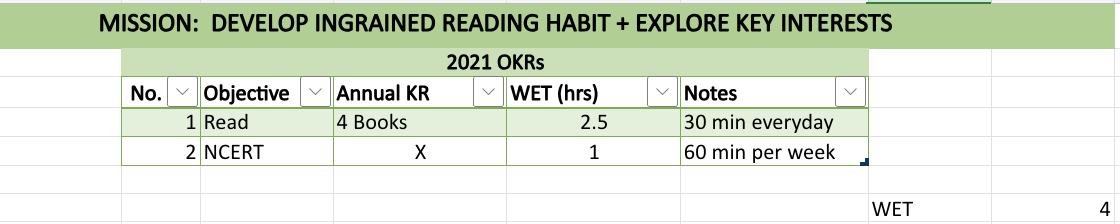
Around this time, I realised I had slowly lost touch with my reading habit. I also felt a persistent urge to revisit my schoolbooks. Somehow, the curiosity that had been exorcised from my system through the vagaries of cramming and periodised testing came alive again.
I wanted to read:
- History
- Geography
- Polity
- The sciences
Anything that would help me understand the world better.
Side note: I had always assumed that you sharpen your understanding of the world as you grow older. My experience proved otherwise.
Early Attempts
I made well-laid plans:
- Organised my reading material
- Created an Excel sheet to track progress
- Calculated Weekly Estimated Time (WET) to complete the NCERT syllabus in a year
- Tried to balance this with work, life, and new interests (this was also when I discovered endurance sports and ultracycling)
I failed.
The Excel sheet gathered digital dust as work and life took over. I made incremental attempts to read more—with some success—but nothing felt structured or sustainable.
The 2025 Pivot
By 2025, during my last year at Sequoia, my interests began trending in a different direction.
Over the preceding three years, I had lived through what felt like epochal events:
- ZIRP
- The crypto boom
- The advent of GenAI
I increasingly felt the need to slow down and just… study and learn.
The overarching goal was to understand:
- Data analysis
- Systems architecture
- AI and LLMs
But I needed a gentler on-ramp. Something that would both rekindle the habit of studying and rebuild my ability to sit and focus.
I chose to start with NCERT books.
The Study Phase
- By March 2025, I had completed the entire NCERT syllabus.
- I then branched out to:
- NIOS (National Institute of Open Schooling)
- IGNOU (Indira Gandhi National Open University)
- By May 2025, my urge to “study” had been largely sated.
More importantly, I now had copious notes across geography, history, polity, and science.
Detour: My Note-Taking Process
Taking notes was non-negotiable.
I knew I wouldn’t retain information beyond the event horizon of my memory. I needed a system that allowed me to revisit and refresh any granular topic quickly.
My evolution looked like this:
- Handwritten notes
- Too slow
- Scaled poorly over long texts
- My handwriting and note density were not conducive to quick comprehension
- Typed notes
- Better structure
- Still slow
Eventually, I decided to augment my note-taking with ChatGPT.
Final Workflow
- Use PDFs of books
- Read an excerpt or chapter
- Feed that text to the LLM
- Prompt for structure, clarity, and coverage
- Edit the output
- Save with appropriate taxonomy in OneNote
(This last choice turned out to be a mistake, as discussed later.)
Where I Ended Up
By the end of this phase:
- I had (for now) satisfied my desire to study the foundational subjects that explain the world.
- I had accumulated ~250 MB of typed notes, amounting to roughly 250,000 pages.
I began to think of these notes explicitly as my second brain.
The Aha Moment
The turning point came when I realised:
I could feed my notes into an LLM, use it as a daily driver for curiosity and queries, and let it paper over the cracks of my memory and recall—subject, of course, to how well I handled hallucinations.
That realisation was the seed from which Aanae grew.